Wasp pressure in Harford County builds from late June and peaks in August and September, when colonies are largest and foragers get aggressive about food and sugar. In Fallston that timing collides with everything the…
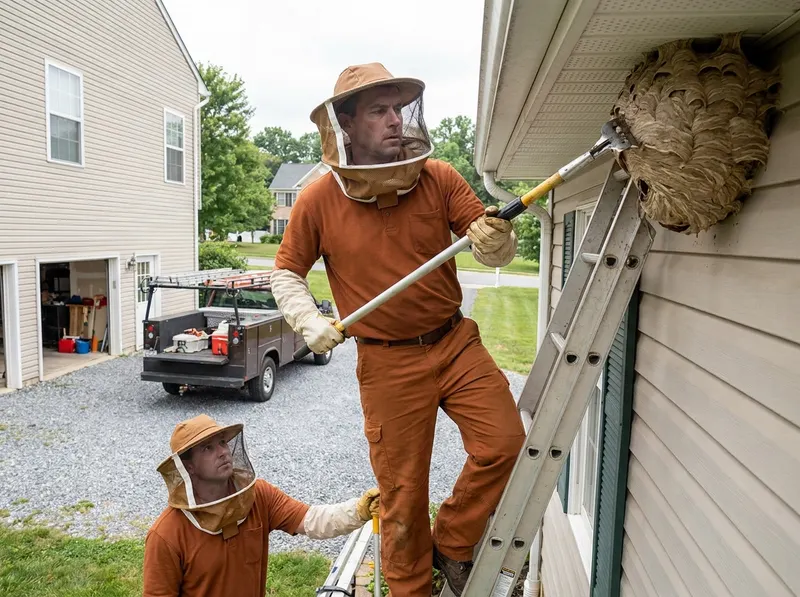
Wasp pressure in Harford County builds from late June and peaks in August and September, when colonies are largest and foragers get aggressive about food and sugar. In Fallston that timing collides with everything the yard is used for: cookouts, Fallston Recreation Council games, mulch beds getting weeded, kids on a swing set. Yellowjackets here nest underground far more often than people expect — in abandoned vole runs along a tree line, under landscape timbers, in the loose soil at the edge of a gravel drive. You usually see the traffic before you see the hole: a steady stream of insects dropping into one spot in the lawn. Bald-faced hornets build the gray football-shaped paper nest, often 12 to 25 feet up in a maple or tucked under a second-story soffit return. European hornets are the big ones that hit porch lights after dark and strip bark from shrubs. Each of those species sits in a different place and needs a different approach, which is why we identify before we treat.
The hard cases in Fallston are the void colonies. On the 1970s through 1990s subdivisions around Pleasantville, Vale and the Trappe Church Road area, yellowjackets get in through a gap at the soffit-to-fascia joint, a failed dryer vent flap, or the seam behind aluminum trim, then build inside the wall or attic knee wall. The tell is a soft rustle in the wall and a handful of wasps appearing inside a bedroom. Sealing that hole before the colony is treated is the worst thing you can do — the workers push inward through drywall looking for a way out. We treat at the entry, wait for traffic to drop, then close the gap. That sequence is the whole job.
When is a one-time nest removal the right call versus a season-long perimeter program? A single visible nest — paper wasps under a deck rail, one ground colony by the shed, hornets in a lilac near Laurel Brook — is a one-time job, and that is what most Fallston homeowners need. A perimeter program makes more sense on wooded lots along the Winters Run corridor or the Little Gunpowder side of Upper Crossroads and Carrs Mill, where new queens found nests every spring under the same eaves and railings and you're calling twice a summer. The honest trade-off: one-time removal solves this nest and does not prevent next April's queens from picking the same sheltered soffit. Sealing gaps and treating nest-friendly surfaces is what changes the pattern.
On DIY: a supermarket foam can, used at dusk, can handle a small open comb of paper wasps you can reach from the ground. It is a poor tool for a ground yellowjacket colony with thousands of workers, a nest above ladder height, or anything inside a wall — those are the situations that produce multiple stings and second attempts. If anyone in the house has a known sting allergy, treat the nest as off-limits and let us do it; call 911 for any breathing or swelling reaction rather than driving to the Fallston Volunteer Fire & Ambulance station. We also talk through product placement around dogs, vegetable beds, and well heads before anything is applied, because most Fallston properties are on well and septic and that matters.
Every quote is a ballpark until we look. The exact price is confirmed on site at a free inspection, before any work starts, and no annual plan is required to get a nest removed.
Every job gets a firm, written price after a free on-site visit.
Tell us about your yellowjacket, wasp and hornet nest removal job in Fallston and we'll send a clear, written quote — usually the same day.
 Pestiqra Pest Control