Fallston gives carpenter ants nearly everything they want. Wooded one-to-three-acre lots off Trappe Church Road and along the Winters Run corridor keep standing dead oak, tulip poplar limbs, and old stumps within easy…
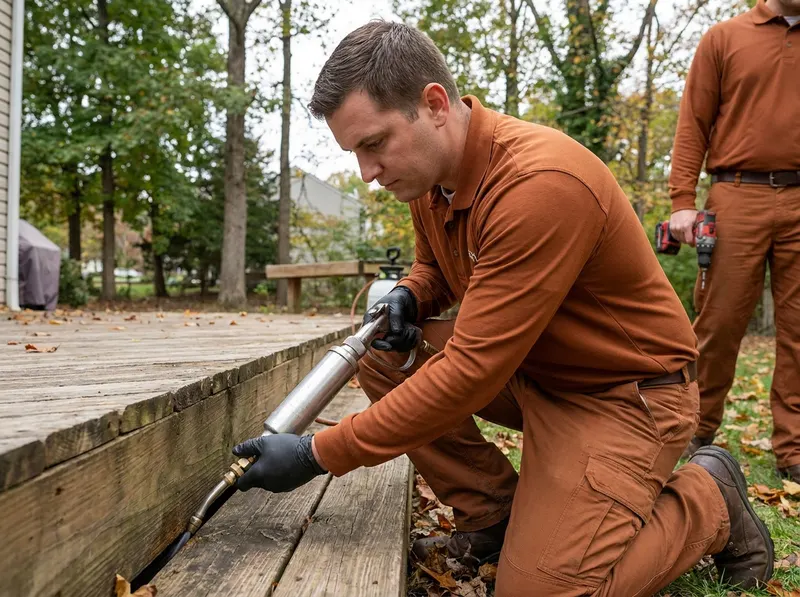
Fallston gives carpenter ants nearly everything they want. Wooded one-to-three-acre lots off Trappe Church Road and along the Winters Run corridor keep standing dead oak, tulip poplar limbs, and old stumps within easy foraging distance of the house — and a black carpenter ant colony will travel well over 100 feet from its parent nest to a satellite nest inside your framing. On the newer-growth streets in Vale and Laurel Brook, we more often find the nest in a wet spot the homeowner already suspected: the corner of the deck where the ledger board meets the siding, a window header under a gutter that overflows, a sill plate above a damp block basement wall, or the sub-floor under a shower pan. Damp wood is the deciding factor, not how clean the kitchen is.
The honest test of a carpenter ant job is whether the technician found frass. Frass is the pile of coarse, sawdust-like shavings mixed with insect body parts and bits of insulation that ants push out of a gallery — you can see it on a basement floor, on a windowsill, or in a thin line down the outside of the foundation. Frass means the nest is in that structure, not just nearby. In April and early May we also get calls from Pleasantville and Upper Crossroads about winged swarmers at sunny windows; carpenter ant reproductives have elbowed antennae, a pinched waist, and two pairs of unequal wings, while termite swarmers have straight antennae, no waist, and four wings of equal length. If we open the inspection and the evidence points to mud tubes rather than frass, we tell you it is a termite question and handle it as one — a wrong diagnosis here costs real money.
Carpenter ant treatment fits when you have evidence of a nest: frass, faint rustling in a wall void after dark, large half-inch black ants indoors in winter (they overwinter, so cold weather does not clear them), or steady trails on a deck rail. A general quarterly perimeter program fits when the pressure is mixed and seasonal — mice, camel crickets, spiders, stink bugs — and you want ongoing coverage rather than a colony solved. The trade-off is honest: a broad perimeter spray suppresses the foragers you see and buys quiet weeks, but leaves the parent nest producing. Nest-directed work costs more up front and takes a second look about two weeks out to confirm activity has actually stopped.
This is also where the store-bought approach usually goes sideways. Sweet gel baits designed for odorous house ants are frequently ignored by carpenter ants, and a can of repellent aerosol sprayed into a wall crack can push a stressed colony to split off new satellite nests deeper in the structure — a worse problem in a harder place to reach. We use non-repellent products the ants carry back to the nest, so the colony is treated rather than scattered. On the well-and-septic properties common between Carrs Mill and the Route 152 / Route 1 crossroads, we keep applications to targeted cracks, voids, and a tight exterior band, tell you the re-entry time for pets before we start, and stay off vegetable beds and wellheads. Then we hand you the part that actually ends the cycle: trim the limbs touching the roof, move the firewood stack off the siding, redirect the downspout, replace the soft trim board. Your perimeter, inspected and sealed shut.
Every job gets a firm, written price after a free on-site visit.
Tell us about your carpenter ant treatment job in Fallston and we'll send a clear, written quote — usually the same day.
 Pestiqra Pest Control