Fallston's rodent pressure comes from the field and forest edge, not the sidewalk. Homes backing the Winters Run corridor, the Little Gunpowder Falls stream valley, and the open acreage around Upper Crossroads and…
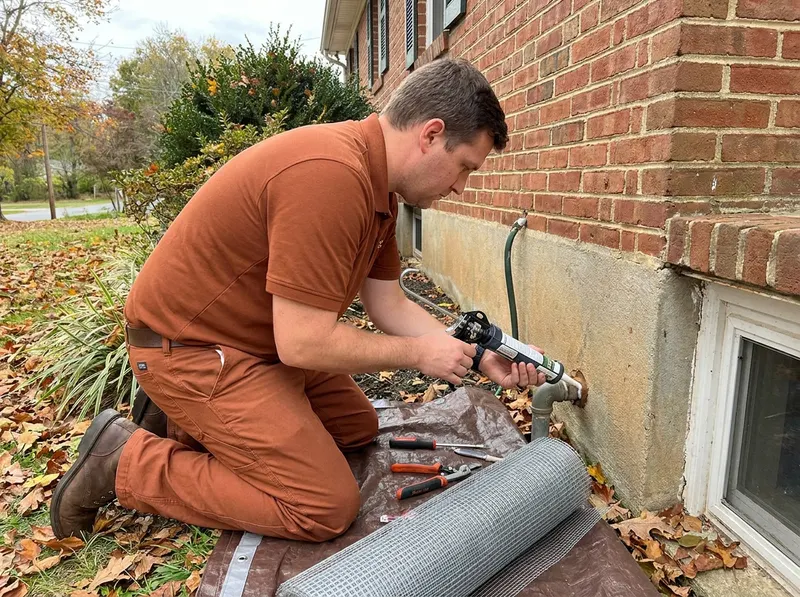
Fallston's rodent pressure comes from the field and forest edge, not the sidewalk. Homes backing the Winters Run corridor, the Little Gunpowder Falls stream valley, and the open acreage around Upper Crossroads and Carrs Mill take a wave of white-footed and deer mice at the first hard frost, when the mice abandon brush piles and stone rows for a warm block basement. In the 1970s–90s subdivisions through Vale, Laurel Brook and Pleasantville, the openings are predictable: a settled sill plate you can see daylight through, an air-conditioner lineset penetration stuffed with nothing, a plastic dryer vent flap chewed at the corner, a garage door with the rubber sweep worn off both bottom corners, and a crawlspace foundation vent with rusted-out screen. Older farmhouse-era properties near the Trappe Church Road area add stone-and-mortar foundations where the joints have washed out. Norway rats show up more often near outbuildings, chicken coops and commercial trash at the Route 152 / Route 1 crossroads in the village center — rats need only about a half-inch gap, and they will widen a soft one.
The inspection comes first and it drives everything else. We walk the full perimeter, count and photograph the openings, get into the crawlspace or basement to check the sill, look at the sump pit conduit, the well line penetration, plumbing chases and the gable vents, then read the evidence — droppings, rub marks along joists, gnawed insulation, cached dog food behind a water heater. That gives you a numbered entry-point map before anyone talks about a plan. Trapping is done with snap traps in interior spaces so there is no loose bait where a dog or a child can reach it; if exterior rodenticide is appropriate, it goes in locked, tamper-resistant stations along the foundation only. Wooded, well-and-septic properties get the conservative version of that on purpose.
Trapping alone is the right choice in a narrow set of cases: a single mouse that walked in an open garage door, a rental turnover where you need the activity gone this week, or a house where you already had exclusion work done and one gap re-opened. It costs less up front and it works on the animals present. The trade-off is honest — it treats the population, not the architecture, so if the sill plate gap and the dryer vent are still open in September, the same run repeats in October. Exclusion sealing is what converts a recurring seasonal problem into a one-time repair. The larger scope makes sense on wooded one-to-three-acre lots, on any house where you have baited two years running, and on crawlspace homes where the vents and utility penetrations all need hardware cloth.
What we do not oversell: no exclusion job seals a house permanently against every future opening — garage sweeps wear, decks get built, mortar cracks. Landlords and small kitchen operators in the Fallston area often want a scheduled monitoring interval after the sealing; homeowners frequently do not need one, and a first visit here does not require signing an annual contract. If the honest answer at your house is "two gaps, three traps, done," that is what you will hear.
Every job gets a firm, written price after a free on-site visit.
Tell us about your mouse and rat removal with exclusion sealing job in Fallston and we'll send a clear, written quote — usually the same day.
 Pestiqra Pest Control