The inspection is measurement work, not guesswork. A house mouse fits through a quarter-inch gap and a young rat through a half-inch, so we carry a gauge to the places that actually open up: the dryer vent flap, the…
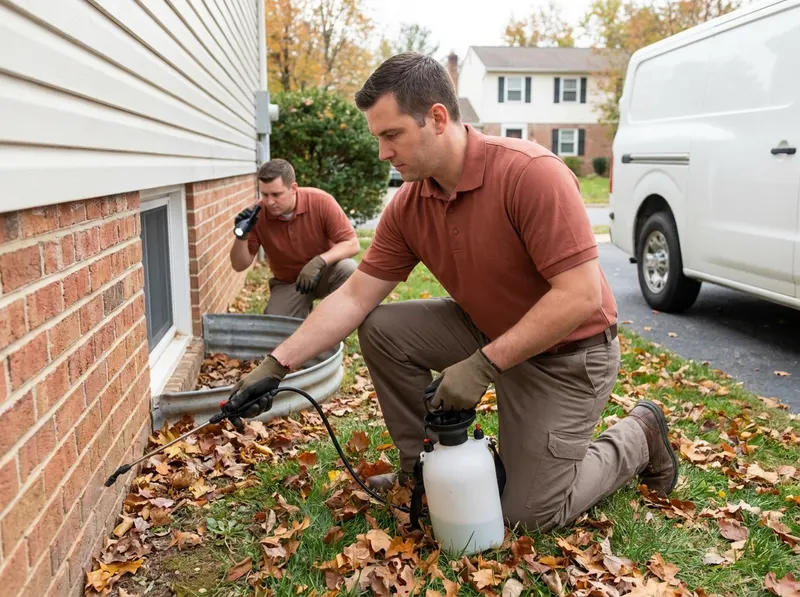
The inspection is measurement work, not guesswork. A house mouse fits through a quarter-inch gap and a young rat through a half-inch, so we carry a gauge to the places that actually open up: the dryer vent flap, the hose bib and AC line-set penetrations, the corners where garage door sweeps have curled, block weep holes, crawlspace vents with rusted screen, and the soffit-to-fascia seam. Inside, we look at the top of the block wall where the sill plate sits — in the 1970s–90s subdivisions around the Fallston village center at Route 152 and Route 1, settling has left daylight gaps behind the band board that no exterior spray ever reaches. We also read the signs: mud tubes on damp basement block, coarse sawdust and frass under window trim from carpenter ants, camel crickets on crawlspace joists, and October stink bug clusters on the sunny south and west siding.
The yard is part of the perimeter. On the wooded acre-plus lots along the Winters Run corridor, Carrs Mill and the Trappe Church Road area, pressure comes from the tree line inward — leaf litter and ivy against the foundation, firewood stacked on the siding, a mulch bed graded above the block, and the shaded transition zone where ticks hold. We note where the wellhead and septic field sit on the map, so any treatment you approve later stays off them. Homeowners in Pleasantville, Vale, Upper Crossroads and Laurel Brook usually learn the entry point is somewhere they had never looked — a crawlspace door that no longer latches, or a gap where a satellite cable was drilled through.
When does the inspection fit, and when should you skip it? Choose the inspection when the problem repeats or you can't name the entry point: mice heard in the ceiling every fall, ants back three springs running, or a house you just bought and don't know yet. Skip straight to targeted treatment when the target is visible and singular — a yellowjacket nest by the deck stairs two days before a cookout gets treated, not surveyed. The honest trade-off: an inspection costs money on day one and kills nothing that afternoon. What it buys is direction, so you stop paying for repeat visits that treat the symptom. Most Fallston repair lists are short — three to eight specific openings — and plenty of customers handle the easy ones themselves with our photos as the guide.
About the two questions we hear most. Yes, hardware-store bait stations and a foam can can work on a light, isolated problem; they fail on recurring invasions because they never address the opening. And no, the inspection does not obligate you to a yearly plan. You get the report and the entry-point map either way. If you want us to do the sealing, exclusion or treatment work, that is quoted separately and in writing.
Every job gets a firm, written price after a free on-site visit.
Tell us about your home perimeter pest inspection job in Fallston and we'll send a clear, written quote — usually the same day.
 Pestiqra Pest Control