Eastern subterranean termites are the termite Fallston homeowners actually meet, and they announce themselves in two ways. Spring swarms come on warm, humid afternoons in April and May, often the day after rain — you…
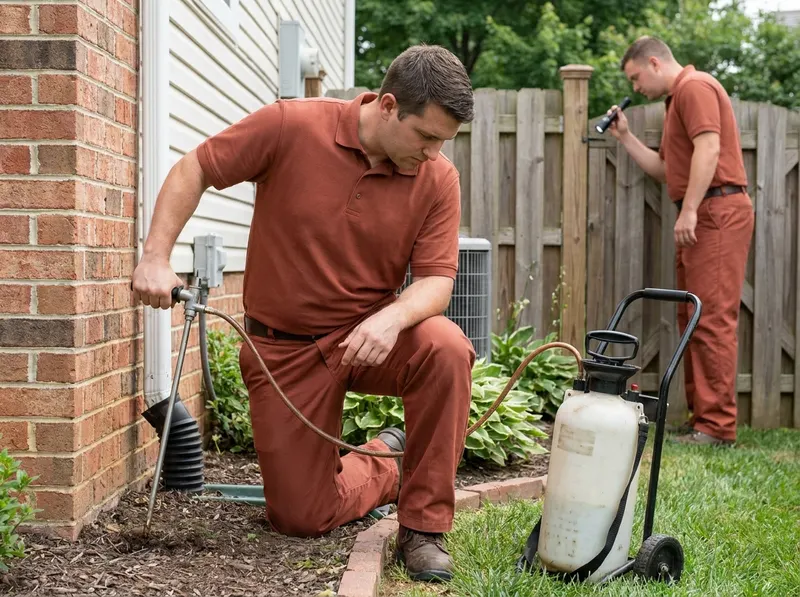
Eastern subterranean termites are the termite Fallston homeowners actually meet, and they announce themselves in two ways. Spring swarms come on warm, humid afternoons in April and May, often the day after rain — you find winged insects at a basement window well or a scatter of equal-length discarded wings on a sill in Pleasantville, Vale or one of the Winters Run corridor lots. The quieter sign is a pencil-width mud tube running up a block foundation wall, behind a stored box, or along a floor joist near a bathroom drain. We probe suspect wood with a screwdriver, follow tubes to where they enter, and photograph what we find so you can see it instead of taking our word for it. Older farmhouses out toward Trappe Church Road and the Carrs Mill area often show activity at porch piers and hand-cut sills; 1970s–90s subdivisions near the Route 152 and Route 1 crossroads more often show it at settled sill plates, attached-garage slab edges and deck ledger boards.
Two treatment approaches cover most Fallston homes, and the trade-off is real. A liquid soil barrier means trenching the soil against the foundation and treating it continuously — sometimes drilling through a slab patio, garage floor or front porch to reach soil underneath. It is more disruptive on the day but it treats foraging termites quickly and covers the whole perimeter. In-ground bait stations require no trenching, which matters on properties where the perimeter is broken up by a well head, septic lines, a poured patio or heavy foundation plantings; the trade-off is that baiting works over months as the colony consumes it, and it depends on the stations being checked on schedule. Because most Fallston properties are on well water and septic, we locate the well head and septic field before any soil application and plan the treatment around them. Wooded lots backing to Little Gunpowder Falls also carry constant pressure from stumps, buried construction scrap and old railroad ties, which is a good argument for monitoring even after a barrier goes in.
What happens after treatment matters as much as the product. Termites need soil moisture and a wood bridge, so the fixes are physical: pull mulch back to two inches below the siding, extend downspouts away from the foundation, get firewood off the ground and away from the wall, and correct grading that pitches water toward the block. Damp block basements and dirt-floor crawlspaces along the Laurel Brook and Upper Crossroads side of town are the two conditions we flag most often, and we will tell you plainly which ones are structural questions for a contractor rather than pest work. Annual re-inspection is how you catch a new entry point early — one visit a year in spring, before swarm season, is the practical schedule for this area.
One clarification that saves homeowners money: carpenter ants and termites both mean insects in wood, and they are treated completely differently. Termites leave mud, no sawdust; carpenter ants leave coarse sawdust and no mud tubes. If you are not sure which one you have, book the inspection and we will identify it before anyone quotes a treatment. General ant, mouse and perimeter work is a separate service — see our main Fallston pest control page for that side of the house.
Every job gets a firm, written price after a free on-site visit.
Tell us about your termite inspection and treatment job in Fallston and we'll send a clear, written quote — usually the same day.
 Pestiqra Pest Control